swarmvault memory
swarmvault memory is the 2.0 compatibility alias for the task ledger. Prefer `swarmvault task` in new workflows. These records are not transcripts; they are compact durable artifacts that capture the goal, linked context packs, decisions, graph evidence, touched paths, outcome, and follow-ups.
Usage
swarmvault memory start <goal> --target <path-or-node> [--budget <tokens>] [--agent <name>]
swarmvault memory update <id> [--note <text>] [--decision <text>] [--changed-path <path>] [--context-pack <id>] [--status active|blocked|completed|archived]
swarmvault memory finish <id> --outcome <text> [--follow-up <text>]
swarmvault memory list
swarmvault memory show <id>
swarmvault memory resume <id> [--format markdown|json|llms]
What It Writes
state/memory/tasks/<id>.json- the structured task recordwiki/memory/tasks/<id>.md- the markdown companion with stable frontmatterwiki/memory/index.md- the task index
memory start also builds an initial context pack and links it to the task unless you provide an existing pack.
Related Commands
query, explore, and context build accept --memory <id> as a compatibility alias for --task <id>.
Examples
swarmvault memory start "Implement the auth refactor" --target ./src --agent codex
swarmvault memory update <id> --decision "Keep session state in the existing store."
swarmvault memory update <id> --changed-path packages/engine/src/memory.ts
swarmvault context build "Review auth refactor" --target ./src --memory <id>
swarmvault memory finish <id> --outcome "Auth refactor shipped" --follow-up "Run installed-package smoke"
swarmvault memory resume <id> --format llms
Graph and Viewer
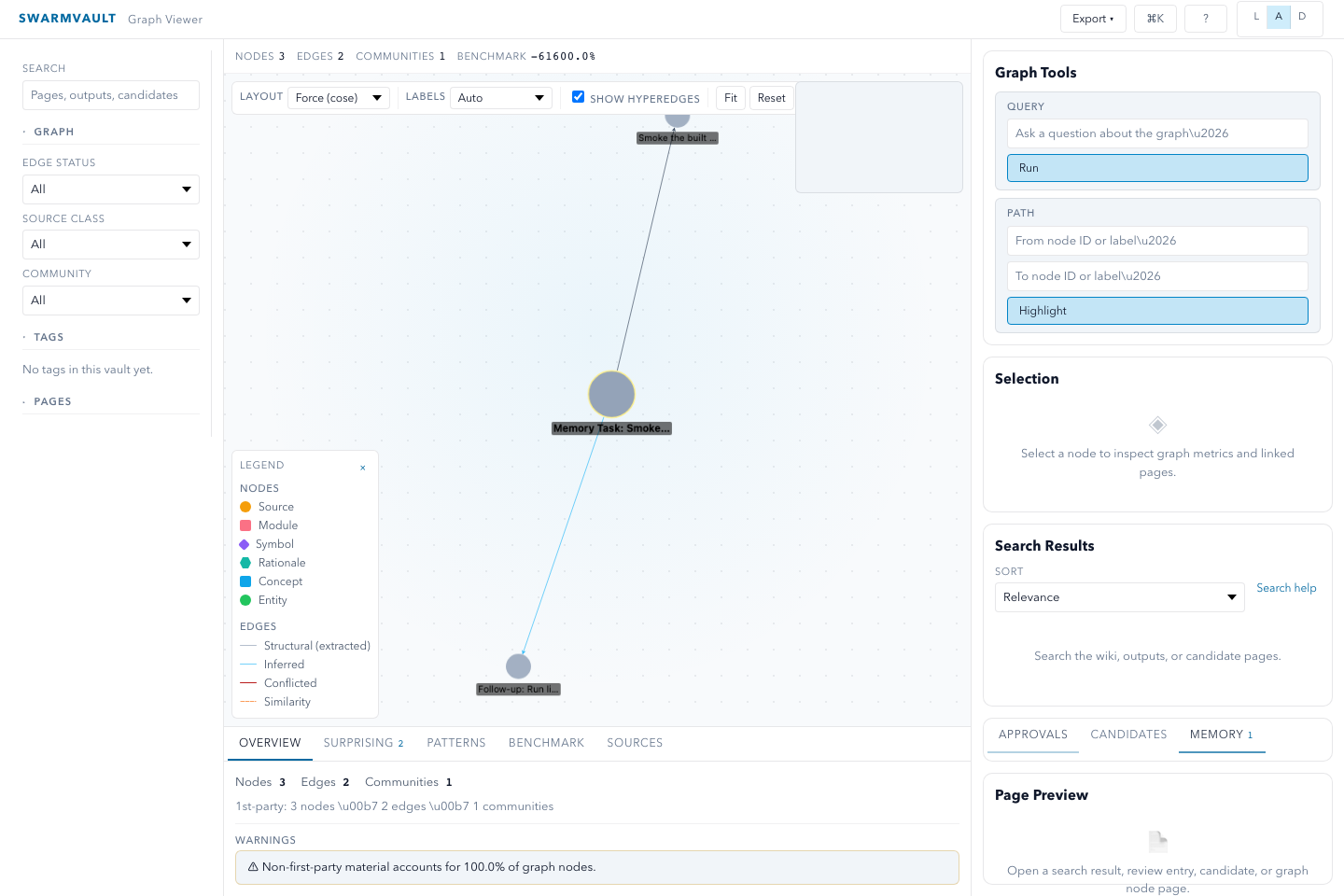
After swarmvault compile, task records become graph nodes and decisions become decision nodes in state/graph.json. The graph viewer includes task history with status filters, task details, linked context packs, changed paths, and related graph navigation.