Examples
These examples are intentionally small and map directly to the worked/ material used in release validation, plus the installed-package source flows used in release smoke.
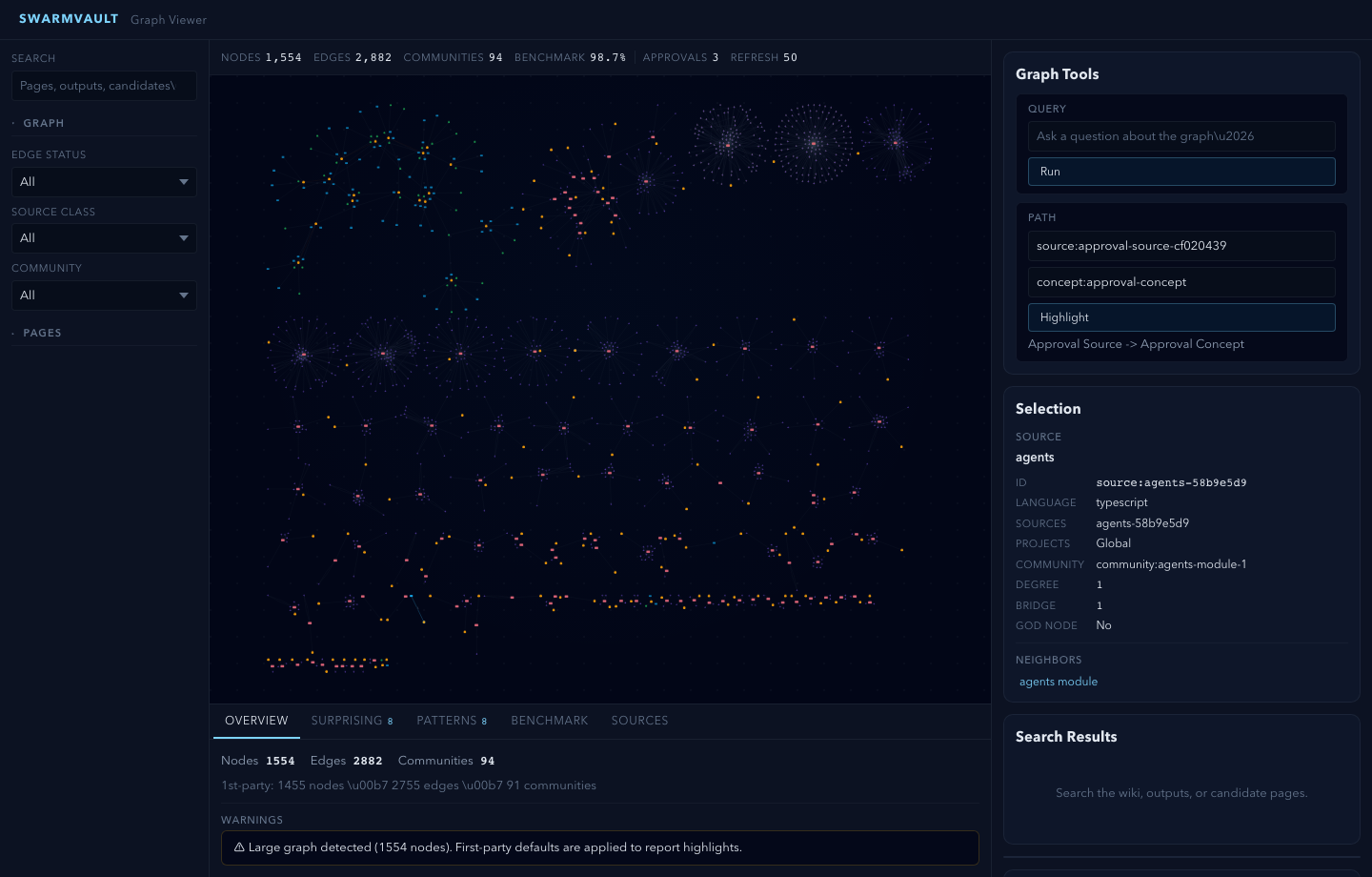
Managed Source Example
Use this when you want the shortest path from a public repo URL to a synced vault plus a first-run brief.
swarmvault init --obsidian
swarmvault source add https://github.com/karpathy/micrograd
swarmvault source list
swarmvault source reload --all
swarmvault graph share --post
swarmvault graph share --svg ./share-card.svg
swarmvault graph share --bundle ./share-kit
swarmvault graph serve
Look for:
state/sources.jsonwith agithub_repoentrystate/sources/<id>/working state for the managed sourcewiki/outputs/source-briefs/<id>.md- the usual
wiki/graph/report.md,wiki/graph/share-card.md,wiki/graph/share-card.svg,wiki/graph/share-kit/,state/graph.json, andstate/retrieval/artifacts after sync
Code Repo Example
Use the tiny repo-shaped example when you want to exercise repo ingest, module pages, graph report generation, and benchmark output together.
swarmvault init --obsidian
swarmvault ingest ./worked/code-repo
swarmvault compile
swarmvault benchmark
swarmvault chat "What should the next agent know about this repo?"
swarmvault context build "Hand off this repo overview" --target ./worked/code-repo --budget 8000
swarmvault export ai --out ./exports/ai
swarmvault task start "Hand off this repo overview" --target ./worked/code-repo --agent codex
swarmvault graph share --post
swarmvault graph share --svg ./share-card.svg
swarmvault graph share --bundle ./share-kit
swarmvault graph serve
Look for:
wiki/code/module pages with local import linksstate/code-index.jsonaliases and repo-relative pathswiki/graph/report.mdpluswiki/graph/report.jsonwiki/graph/share-card.mdfor compact post-ready text,wiki/graph/share-card.svgfor the visual card, andwiki/graph/share-kit/for the portable HTML-preview bundlewiki/outputs/chat-sessions/andstate/chat-sessions/when the chat command is used for resumable follow-upwiki/context/andstate/context-packs/when the context-pack command is used for handoffexports/ai/withllms.txt,graph.jsonld, and manifest files when the AI export command is usedwiki/memory/andstate/memory/tasks/when the memory command is used for durable task handoffstate/benchmark.json
Research Capture Example
Use the capture workflow when you want normalized metadata and durable markdown before the source enters the standard compile path.
swarmvault init
swarmvault add https://arxiv.org/abs/2401.12345
swarmvault add 10.5555/example-doi
swarmvault add https://example.com/article
swarmvault compile
swarmvault query "What does the captured research say about trust signals?"
swarmvault chat "What should I read next?"
swarmvault export ai --out ./exports/ai
Look for:
source_type,canonical_url,authors, and publication metadata in the stored raw markdown- localized remote assets under
raw/assets/for article captures - compiled source pages in
wiki/sources/ - research-aware search and graph entries inside the local workspace UI
- chat transcripts under
wiki/outputs/chat-sessions/and static handoff files under the export directory when those commands are used
Review And Save-First Example
Use this loop when you want generated work to stay inspectable instead of mutating the vault silently.
swarmvault init
swarmvault ingest ./worked/mixed-corpus
swarmvault compile --approve
swarmvault review list
swarmvault review show <approval-id>
swarmvault query "What should I save as a report?" --format report
swarmvault candidate list
Look for:
- staged compile changes in
state/approvals/ - candidate concept/entity pages in
wiki/candidates/ - saved report outputs under
wiki/outputs/ - refreshed graph/report artifacts after accepted changes
Book Reading Example
Use this when you want a chapter-by-chapter reading companion that compounds into a fan wiki instead of a pile of isolated notes.
swarmvault init --obsidian
cp ./worked/book-reading/raw/chapter-1.md raw/
swarmvault ingest raw/chapter-1.md
swarmvault compile
swarmvault query "What is the Thornback discrepancy and why does it matter?"
Look for:
wiki/entities/pages for recurring characters like Maren Voss and Dr. Tomas Lunewiki/concepts/or related pages for themes, disputes, and settings that grow across chapters- denser backlinks and cross-references each time you ingest another chapter
- query answers that synthesize plot threads across multiple chapters instead of one file at a time
Add chapter-2.md and chapter-3.md the same way to watch the wiki compound as the book progresses.
Research Deep-Dive Example
Use this when you want an evolving thesis wiki from overlapping papers and practitioner notes, with contradiction checks across claims.
swarmvault init --profile personal-research
swarmvault ingest ./worked/research-deep-dive/raw/rag-survey-2024.md --guide
swarmvault ingest ./worked/research-deep-dive/raw/compiled-knowledge-karpathy.md --guide
swarmvault ingest ./worked/research-deep-dive/raw/hybrid-approaches-2025.md --guide
swarmvault ingest ./worked/research-deep-dive/raw/production-rag-lessons.md --guide
swarmvault compile
swarmvault lint --deep
Look for:
- thesis and concept pages that shift as new sources disagree or add nuance
- source-linked claims under
wiki/sources/and concept/entity pages - contradiction findings from
lint --deepwhen sources disagree on retrieval quality or hybrid approaches - guided-ingest artifacts that make each source addition inspectable before it reshapes the wiki
Personal Knowledge Base Example
Use this when you want a personal Memex that connects journals, health logs, podcast notes, and goals into one durable vault.
swarmvault init --obsidian --profile personal-research
swarmvault ingest ./worked/personal-knowledge-base/raw
swarmvault compile
swarmvault query "How does my sleep relate to my productivity?"
swarmvault chat "What patterns should I follow up on?"
swarmvault graph serve
Look for:
- source pages in
wiki/sources/for each journal, podcast, health, and goals entry - entity and concept pages that connect the same people, projects, and habits across source types
- dashboards and graph links that make recurring patterns visible across otherwise unrelated notes
- saved query outputs in
wiki/outputs/that cite across multiple personal sources - saved chat sessions in
wiki/outputs/chat-sessions/when you want follow-up prompts to remain reusable
Source Material
The example inputs live in the repo so the docs and smoke tests stay aligned:
worked/code-repo/worked/mixed-corpus/worked/capture/worked/book-reading/worked/research-deep-dive/worked/personal-knowledge-base/
If you want to start with the pattern before installing the CLI, use the standalone LLM Wiki schema template.
For real public-repo validation against the installed npm package, see OSS Validation.
When you refresh screenshots or docs examples, prefer running the installed CLI against those inputs rather than the workspace source tree directly.